Every transformation has an Executive Sponsor. Most have a Program Director, a PMO and consulting partners.
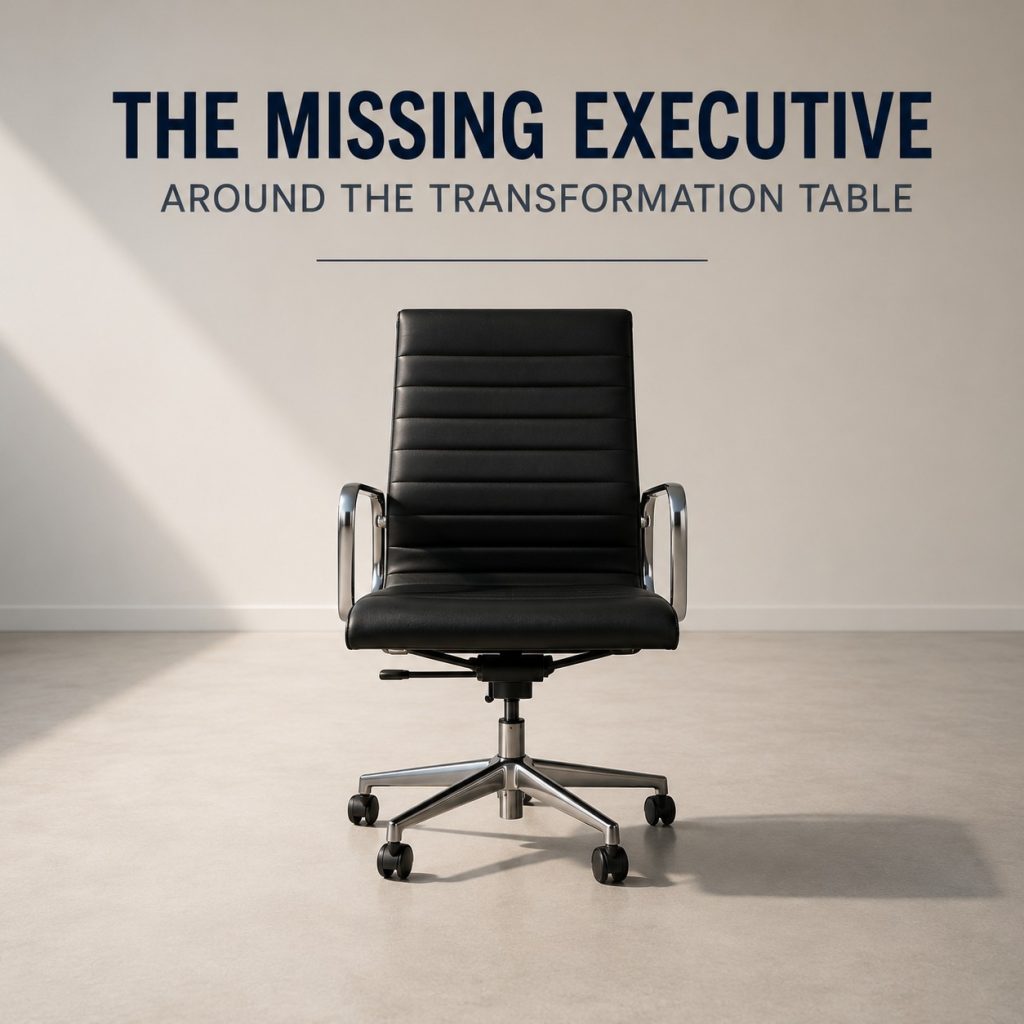
One key executive may still be missing.
Warning: this piece may annoy transformation leaders, whether in IT, Business or Consulting. And maybe a few executives and Boards. It’s meant to.
Businesses generally adopt one of two approaches to transformation.
The first is the DIY approach. Operational leaders juggle two full-time jobs — running the business while landing the transformation. Project resources and business SMEs are brought in to support delivery. It’s the classic “fixing a plane whilst it is flying.”
The second establishes a dedicated program team with formal governance, delivery and risk structures. Even the best-designed programs eventually encounter headwinds. Governance becomes heavier, accountability blurs, milestones slip, budgets stretch and compromises quietly creep in.
Both approaches can succeed. Neither is immune from challenges.
Transformation is complex. It brings together tech, ops, people, customers, regulation, compliance and commercial objectives. No governance model can anticipate every issue.
Over the past 25 years I’ve led and participated in many transformations. I’ve also contributed to — and read — more than my fair share of Post Implementation Reviews.
PIRs usually cover familiar themes: governance, communication, leadership, change management, business readiness, stakeholder engagement.
And yet, one role is rarely discussed: an executive whose job is to bridge the program, the business and the customer — a trusted advisor to the Executive Sponsor.
Their sole focus isn’t project delivery. It’s ensuring the business actually lands the transformation.
They keep strategic objectives, operational risks and customer outcomes firmly in view. They challenge assumptions, interpret program reporting through an operational lens, identify emerging issues before they become customer problems, and provide independent advice that balances project success with business success.
They have permission to ask uncomfortable questions:
Are we solving the right problem, or simply implementing the agreed solution?
Are vendors driving priorities?
Do we have the right capability across the business, the program and our partners?
As budgets come under pressure, are we still investing where it delivers the greatest value?
Most importantly, they keep bringing the conversation back to why the transformation exists.
Technology is only one part of the equation. Customers don’t judge a transformation by whether it went live on time. Boards don’t judge it by the number of milestones achieved. They judge it by the outcomes it delivers.
Before your next SteerCo, ask one simple question: who around the table is independently advising the Executive Sponsor that the business — not just the project — is on track?
If nobody owns that question, that may be your biggest transformation risk.